401k Calculator Excel Formula: FV, Match Caps, and Year Tables

Use Excel FV and year-by-year formulas for a 401k calculator — including employer match caps and contribution limits you can sanity-check.
Search for a 401k calculator excel formula and AI overviews will hand you =FV(rate, nper, pmt, pv). That is the right starting point — and incomplete once employer match tiers and raises appear. This guide shows when FV is enough and how to extend into match caps and year tables. For template selection, sheet layout, and free vs paid trade-offs, start with the 401k calculator excel template hub.
Key takeaway: Use FV for constant contributions; use a year table when match, raises, or changing deferral percents matter. Keep pmt and pv signs consistent.
The FV pattern
Excel’s future value function:
=FV(rate, nper, pmt, [pv], [type])
- rate — expected return per period (annual 7% →
0.07yearly, or0.07/12monthly) - nper — number of periods
- pmt — contribution per period as a negative number if you follow cash-flow sign convention
- pv — current balance as a negative number under the same convention
- type — 0 end of period, 1 beginning
Example directional annual model:
=FV(0.07, 30, -6000, -25000)
That assumes $6,000 total annual additions and $25,000 starting balance at 7% for 30 years. It does not by itself model a tiered match.
[TABLE: Formula choice]
| Need | Formula approach |
|---|---|
| Quick total, flat contributions | FV |
| Match with a cap | Helper cells + MIN |
| Raises each year | Year table |
| Fees drag | Net return = gross − fee, or separate fee column |
Employer match without tears
Example single-tier: employer matches 100% of deferrals up to 4% of salary.
- Employee $ =
salary * deferral_pct - Match eligible =
salary * 0.04 - Employer $ =
MIN(employee_dollars, match_eligible)
Two-tier plans need stepwise logic (first 3% at 100%, next 2% at 50%). Put each tier on its own helper row so auditors can read it. Microsoft Learn threads on dual Roth/pre-tax match show how messy payroll definitions get — keep the spreadsheet rule explicit.
Year-by-year when FV is not enough
Columns: Year | Beginning balance | Employee $ | Employer $ | Growth | Ending balance.
Growth example: =(Begin + Employee + Employer) * rate or apply growth only on begin balance if that is your documented convention — pick one. Ending = begin + employee + employer + growth. Next year’s begin = this ending. Optional: grow salary with (1+raise) before computing next year’s contributions.
Video walkthroughs such as “Create a 401K Growth Calculator in Excel” and FV demos on YouTube mirror this structure. Free template shops and marketplace listings also ship prebuilt FV sheets; verify formulas before trusting them.
Structured workbook option
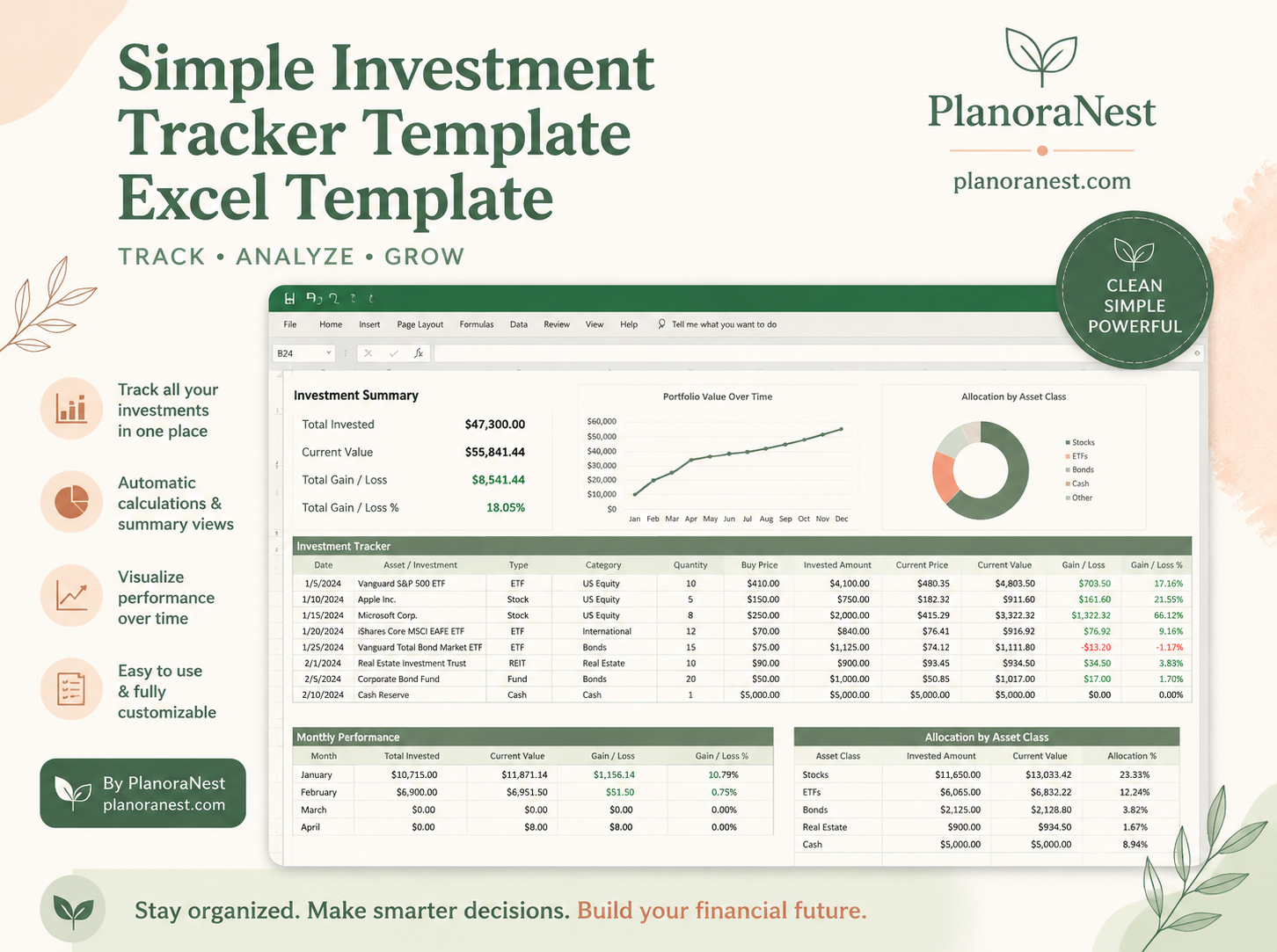
If you want Balance and Help sheets already wired, use the PlanoNest 401K Calculator Excel Template as a one-time purchase with instant download. Confirm live pricing on the product page rather than copying old screenshots.
Product highlight: Wrong period rate (annual vs monthly) creates larger errors than most rounding debates.
Formula QA checklist
- Signs on
pmt/pvconsistent with how you read positive results. - Rate and nper use the same period length.
- Match uses
MIN(or tier steps), not a flat percent of salary regardless of deferral. - Annual limit is a soft check, not silently ignored.
- Year-one ending balance matches a hand calculation.
Keep projections decision-ready for 401k calculator excel formula
Readers searching for 401k calculator excel formula usually want a file they can revisit after a raise, a job change, or a plan redesign. Keep assumptions labeled on a Start Here sheet: expected return, salary growth, contribution percent, match rule, and whether contributions land monthly or annually. When two scenarios matter, duplicate the workbook or add a Scenario column rather than overwriting the only set of inputs.
Reconcile the model against a recent pay stub and your plan summary. If the spreadsheet match does not look like the employer match on the stub, fix the rule before you trust a thirty-year ending balance. The same discipline applies to annual elective deferral limits: treat published IRS limits as planning inputs you update each year, not as forever constants baked into a locked formula.
Stress-test with one lower return and one higher contribution. The point is not to invent a precise fortune. It is to see which lever moves the ending balance enough to change behavior this year. Link back to the cluster pillar when you need the wider download decision, and open the product page only when you want a structured workbook instead of another blank grid.
Keep projections decision-ready for 401k calculator excel formula
Readers searching for 401k calculator excel formula usually want a file they can revisit after a raise, a job change, or a plan redesign. Keep assumptions labeled on a Start Here sheet: expected return, salary growth, contribution percent, match rule, and whether contributions land monthly or annually. When two scenarios matter, duplicate the workbook or add a Scenario column rather than overwriting the only set of inputs.
Reconcile the model against a recent pay stub and your plan summary. If the spreadsheet match does not look like the employer match on the stub, fix the rule before you trust a thirty-year ending balance. The same discipline applies to annual elective deferral limits: treat published IRS limits as planning inputs you update each year, not as forever constants baked into a locked formula.
Stress-test with one lower return and one higher contribution. The point is not to invent a precise fortune. It is to see which lever moves the ending balance enough to change behavior this year. Link back to the cluster pillar when you need the wider download decision, and open the product page only when you want a structured workbook instead of another blank grid.
Keep projections decision-ready for 401k calculator excel formula
Readers searching for 401k calculator excel formula usually want a file they can revisit after a raise, a job change, or a plan redesign. Keep assumptions labeled on a Start Here sheet: expected return, salary growth, contribution percent, match rule, and whether contributions land monthly or annually. When two scenarios matter, duplicate the workbook or add a Scenario column rather than overwriting the only set of inputs.
Reconcile the model against a recent pay stub and your plan summary. If the spreadsheet match does not look like the employer match on the stub, fix the rule before you trust a thirty-year ending balance. The same discipline applies to annual elective deferral limits: treat published IRS limits as planning inputs you update each year, not as forever constants baked into a locked formula.
Stress-test with one lower return and one higher contribution. The point is not to invent a precise fortune. It is to see which lever moves the ending balance enough to change behavior this year. Link back to the cluster pillar when you need the wider download decision, and open the product page only when you want a structured workbook instead of another blank grid.
Keep projections decision-ready for 401k calculator excel formula
Readers searching for 401k calculator excel formula usually want a file they can revisit after a raise, a job change, or a plan redesign. Keep assumptions labeled on a Start Here sheet: expected return, salary growth, contribution percent, match rule, and whether contributions land monthly or annually. When two scenarios matter, duplicate the workbook or add a Scenario column rather than overwriting the only set of inputs.
Reconcile the model against a recent pay stub and your plan summary. If the spreadsheet match does not look like the employer match on the stub, fix the rule before you trust a thirty-year ending balance. The same discipline applies to annual elective deferral limits: treat published IRS limits as planning inputs you update each year, not as forever constants baked into a locked formula.
Stress-test with one lower return and one higher contribution. The point is not to invent a precise fortune. It is to see which lever moves the ending balance enough to change behavior this year. Link back to the cluster pillar when you need the wider download decision, and open the product page only when you want a structured workbook instead of another blank grid.
FAQ
Should contributions be negative in FV?
Under standard Excel cash-flow signs, yes for money you pay in. Some templates flip signs and show negative FV — pick a convention and stick to it.
How do I model fees?
Reduce the return assumption, or subtract a fee dollar column each year. Document which method you chose.
Is CAGR the same as expected return?
No. CAGR looks backward between two known balances. Expected return is a forward assumption in FV or the growth column.
Disclosure
PlanoNest sells related templates. Not tax or investment advice.
About the author
Robin is the independent maker behind PlanoNest.