Excel Attendance Sheet Template: Choose & Use

Compare free downloads, DIY grids, and a structured Excel attendance sheet template for employees — COUNTIF totals, status codes, and monthly records without writing a fixed price.
An excel attendance sheet template should answer a simple question quickly: who was present, absent, late, excused, or off on a given day? That sounds small until you are reconciling employee attendance, classroom records, training check-ins, or staff presence for a full month. A clean workbook gives you names, dates, status codes, and totals without turning attendance into appointment scheduling or shift roster planning.
Search results mix Microsoft template galleries, WPS downloads, Smartsheet attendance roundups, tutorial posts, free template sites, and time-tracking vendors. This guide helps you choose between a free download, a DIY workbook, and a structured paid file. PlanoNest sells templates; when this article links to the PlanoNest product or collection, those links point to our own template shop.
Key takeaway: The best attendance sheet in Excel uses a stable name column, date columns, a short status-code legend, COUNTIF totals, and printable monthly records. Avoid layouts that confuse attendance with scheduling, booking, or payroll timesheets.
Explore the attendance sheet cluster [CLUSTER_NAV]
- How to Make Attendance Sheet in Excel
- Attendance Sheet in Excel: What It Is For
- Attendance Sheet Format in Excel: Layouts That Work
- Monthly Attendance Sheet Excel Free Download: What to Check
- Attendance Tracker Excel: Dashboards and Patterns
What an Excel attendance sheet template should include
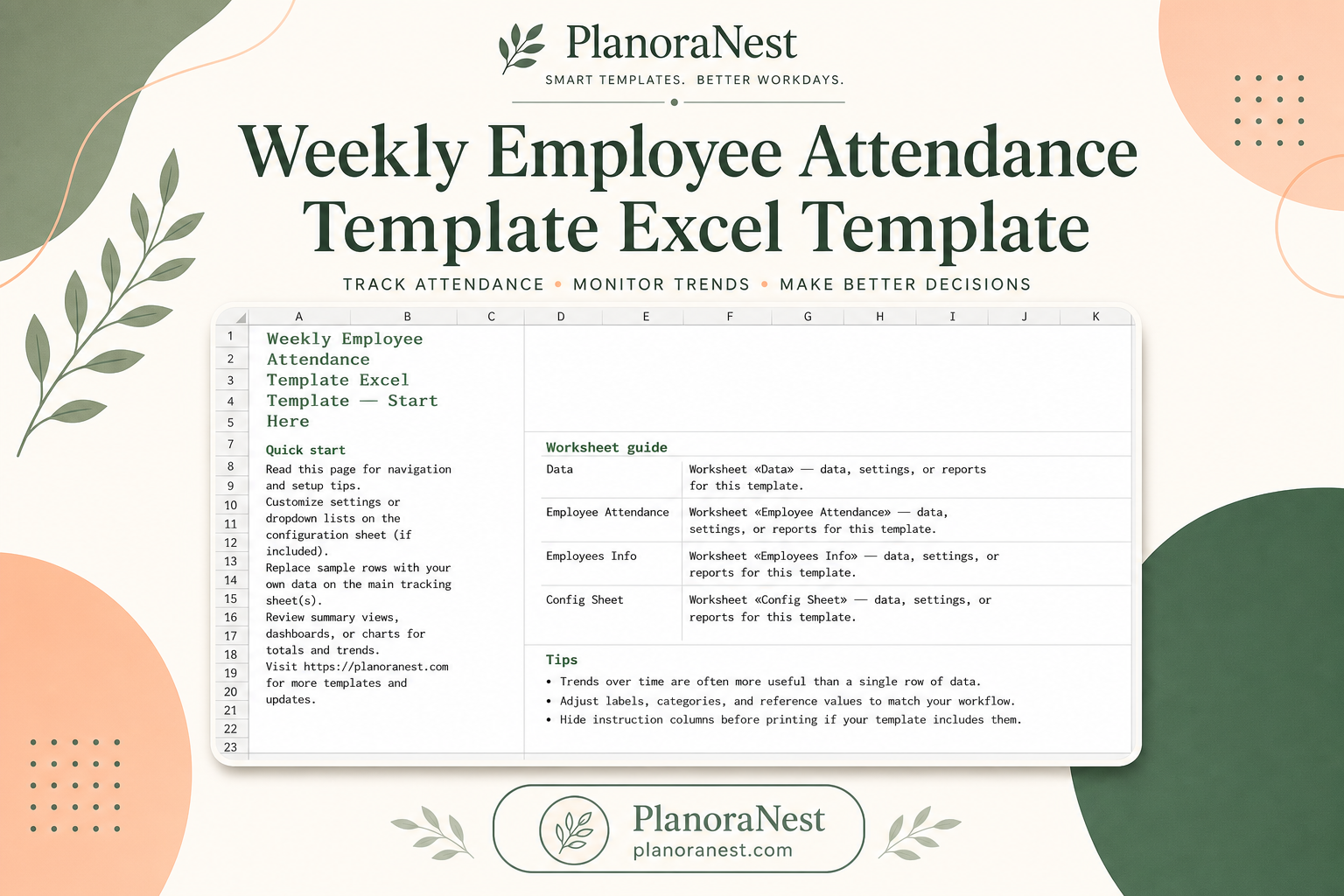
At minimum, an attendance sheet template excel file needs a person list and a date range. For employees, that usually means Employee Name, Employee ID, department, and day-by-day status. For a class, it may be Student Name, group, and dates. For events, it may be registrant, session, and check-in status.
Core attendance workbook parts
| Part | Purpose | Common mistake |
|---|---|---|
| Names / IDs | Identify each person consistently | Sorting names without a stable ID |
| Date columns | Record daily attendance | Hiding weekends without labeling them |
| Status legend | P, A, L, E, WO, or similar | Letting users type free-form notes |
| Summary totals | Count present, absent, late, leave | Counting blanks as absences |
| Printable view | Monthly sign-off or classroom binder | Wide grid that cuts off dates |
This is different from a timesheet. A timesheet records hours worked, job codes, or billable time. An attendance sheet records presence or absence. If you need exact clock-in/out, overtime, labor costing, or legal payroll calculations, connect Excel to a proper timekeeping process instead of forcing a monthly grid to do payroll work.
Free download, DIY grid, or paid structured workbook
Free downloads are useful when you need ideas fast. Microsoft and WPS galleries provide quick starting points, and Smartsheet-style roundups show daily, weekly, monthly, employee, and student formats. Free template sites can also be useful for inspiration, including Vertex42 as a plain-text example, but this draft does not include a Vertex42 hyperlink.
DIY in Excel works well when your rules are simple. Start with one row per person, one column per date, a data-validation list for P/A/L/WO, and COUNTIF formulas for totals. The how-to guide in this cluster walks through the build.
A structured paid workbook makes sense when you want onboarding notes, consistent formulas, and a file that is ready to customize rather than rebuild. The PlanoNest Attendance Sheet Template for Excel is a one-time purchase with instant digital download; check the product page for current details rather than relying on a fixed price in an article.
Attendance codes that keep records clear
Short codes are better than long typed words because formulas can count them reliably. A common employee or classroom setup is:
Attendance status codes
| Code | Meaning | Counted as |
|---|---|---|
| P | Present | Present total |
| A | Absent | Absence total |
| L | Late | Late total, sometimes present |
| E | Excused | Excused absence or note |
| WO | Weekend / off day | Excluded from absence rate |
The exact codes matter less than consistency. If your organization uses U/E/T like some free templates, or check marks and letters like time-tracking guides, keep that legend visible. Lock formulas and use data validation so a typo like "Absent " does not disappear from totals.
When Excel is enough
Excel is enough for small teams, classrooms, clubs, workshops, and monthly staff presence records where one person maintains the file and the reporting need is modest. It is also useful when you need an offline copy, a printable sign-off page, or a quick audit trail by month.
Warning: Excel is not the best primary system for complex scheduling, appointment booking, shift swaps, biometric clock-ins, or multi-location payroll compliance. Use the attendance sheet as a record, not as a substitute for systems that trigger pay, legal notices, or staffing coverage.
For a deeper definition of attendance records versus timesheets, read Attendance Sheet in Excel. For layout choices, continue to Attendance Sheet Format in Excel.
How to evaluate any attendance template
Attendance template checklist
- Confirm the file is about presence/absence, not shift planning or appointments.
- Check that status codes are documented on the sheet.
- Test one present, one absent, and one late mark to see totals update.
- Print or preview a month before using it for real records.
- Look for protected formulas or clear instructions so non-experts do not break totals.
- Confirm whether weekends, holidays, and leave days are excluded from absence rates.
Product fit and next step
If you only need a one-off sign-in page, build a simple sheet or try a free download. If you need a reusable monthly attendance workbook with formulas and a cleaner starting point, open the PlanoNest attendance sheet product page. PlanoNest sells this as a digital template, and the product page is the right place to verify current pricing and included files.
You can also browse related files in the Planner Templates collection if attendance is part of a broader operations or classroom planning workflow.
Keep attendance data easy to audit
Attendance sheets become risky when every supervisor invents a new mark. Put the legend near the top, protect formula cells, and keep raw daily marks separate from summary totals. A monthly grid should let someone trace a total absence count back to the exact date columns without guessing whether a blank means absent, unknown, or not scheduled.
If the workbook supports multiple groups, copy the same headers across each sheet. Do not let one class use P/A while another uses 1/0 unless the formulas are deliberately different. Consistent status codes are what make COUNTIF totals trustworthy at month end.
Make printing boring and reliable
Many attendance files are reviewed on screen but signed on paper. Test print settings before the first real month: landscape orientation for wide grids, repeating header rows, narrow margins, and a footer with file name or month. A readable printed record matters for classrooms, staff rooms, and event check-in binders.
Avoid merged cells across date columns. They look polished in a mockup and then break sorting, filtering, or copying. Use centered headings and borders instead. Excel rewards plain structure when the sheet has to survive twelve months of edits.
Protect privacy without overbuilding
Attendance is operational data, not a public leaderboard. Share only the workbook or tab each manager or teacher needs. If absence reasons include medical or HR-sensitive notes, keep those notes in a separate protected column or system and summarize only the attendance status in the main grid.
For small teams, a locked workbook with named editors may be enough. For larger organizations, Excel should feed a formal HR, payroll, LMS, or timekeeping process instead of trying to become that system.
Troubleshooting common attendance sheet problems
Totals do not match the visible marks. Check for trailing spaces in status codes and use data validation so P, A, L, and WO are selected from a list.
Weekend columns inflate absence counts. Mark weekends as WO or exclude those columns from the absence formula.
Rows move out of order. Freeze panes and sort by a stable ID or name column before publishing a monthly copy.
The sheet is turning into a schedule. Keep shift planning, appointment booking, and calendar assignments in separate tools; this workbook records presence and absence.
Frequently Asked Questions
What is the best format for an attendance sheet in Excel?
A monthly grid is the most common: names down the left, dates across the top, status codes in the middle, and totals on the right. Daily list formats are better for events or sign-in sheets.
Can Excel calculate attendance percentage?
Yes. Count present days divided by counted attendance days, excluding weekends or off days if your policy requires it. The tracker article covers percentage formulas.
Is an attendance sheet the same as a timesheet?
No. Attendance records presence or absence. A timesheet records hours, jobs, or pay-related time details.
Should I use free attendance templates?
Free files are fine for testing layouts. Check formulas, status-code rules, print settings, and whether the workbook pushes you into software you do not need.
Where can I learn to build my own attendance sheet?
Start with How to Make Attendance Sheet in Excel, then compare your result against the template checklist above.