Time Log Spreadsheet: Build a Day-by-Day Activity Record

Use a time log spreadsheet to record daily activities, billable blocks, and priorities — without turning it into a class schedule or payroll card.
A time log spreadsheet is a deliberate diary of blocks — not a wall calendar of future classes and not a biweekly punch card. Freelancers use it to reconstruct invoices. Team leads use it to see where “busy” went. The sheet only works if you treat it like evidence, not decoration.
Start with the selection hub: Daily Time Log Excel Template.
Key takeaway: Keep the spreadsheet boring on purpose: stable headers, consistent activity labels, and a Friday review. Fancy charts can wait until two weeks of honest rows exist.
Why Spreadsheet Logs Still Win for Many People
Timer apps are excellent when you remember to press Start. Spreadsheets win when:
- Clients demand a shareable
.xlsxor PDF of daily narrative. - You already live in Excel or Google Sheets for estimates and invoices.
- You need offline control without another SaaS seat.
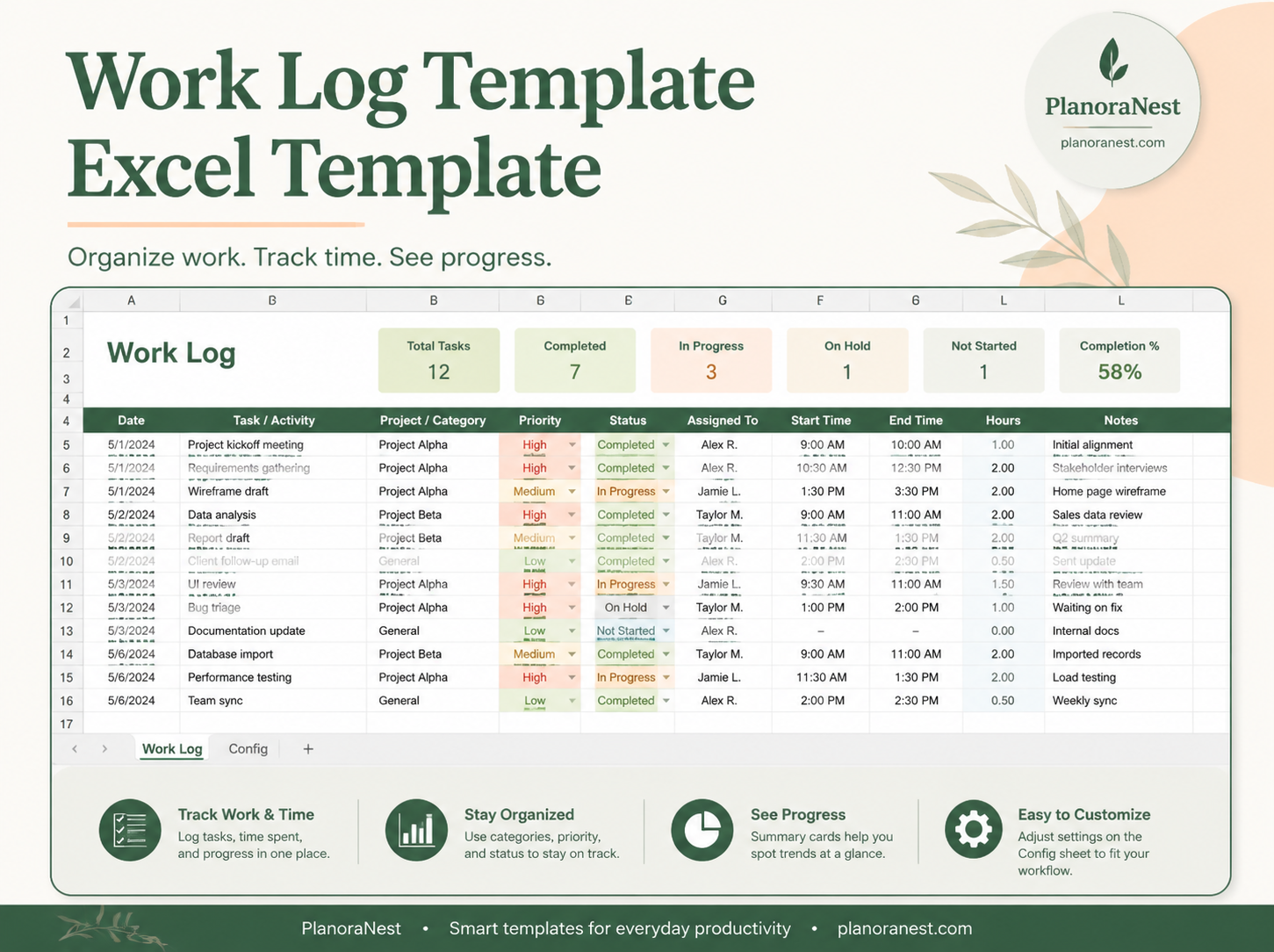
Toggl’s spreadsheet guidance and Hubstaff’s time-log articles both stress the same basics: date, start/end, task description, duration, and regular review. Smartsheet’s free time-log pack shows hourly, daily, weekly, and monthly shapes — useful samples even if you later prefer a single running log.
Design Rules for a Spreadsheet You Will Fill
Design rules
| Rule | Why |
|---|---|
| One convention for time | Mixing duration-only and start/end rows breaks audits |
| Controlled vocabulary | “Email” vs “Emails” vs “Inbox” destroys SUMIF |
| Daily total visible | A top-of-sheet SUM keeps you honest by 3 p.m. |
| Separate archive files | Giant forever-sheets get slow and scary |
| No schedule columns | Future class periods belong elsewhere |
Weekly Operating Rhythm
Weekly time log spreadsheet rhythm
- Monday — confirm headers and activity dropdown list.
- Daily — enter blocks while context is fresh.
- Wednesday peek — if Admin already ate six hours, redistribute.
- Friday review — filter by Client/Project; note surprises in a Notes cell.
- Month end — copy the file to an archive folder; start a clean month sheet if needed.
Spreadsheet vs Dedicated Time Software
Be honest about scale:
- Spreadsheet — best for solo or small teams, narrative billing, light reporting.
- Timer software — better when you forget to log, need reminders, or manage large teams.
You can start in a sheet and graduate later. Do not pretend a blank grid will behave like an automatic timer.
Getting a Structured Starting Point
If building columns from scratch keeps slipping, use a prepared daily log. The Daily Time Log Excel Template (PlanoNest — disclosure: we sell it) is a one-time-purchase workbook aimed at daily activity rows and work descriptions. Live price sits on the product page.
Path choice details live on the hub.
Keep the log boring on purpose
Fancy dashboards feel productive and then go stale. A durable daily time log is slightly boring: stable headers, predictable activity words, and Duration cells that always mean the same thing. Resist sparkline art unless your team already uses that language in standups.
Name archive files with months, not "Final_v7_REAL". If you need history for client disputes, keep monthly snapshots in a read-only folder instead of one immortal tab that never ends.
Mobile editing is a bonus, not the design center. Optimize for the laptop review you actually do, then confirm Google Sheets behavior if someone must add a row from a phone.
Keep the log boring on purpose
Fancy dashboards feel productive and then go stale. A durable daily time log is slightly boring: stable headers, predictable activity words, and Duration cells that always mean the same thing. Resist sparkline art unless your team already uses that language in standups.
Name archive files with months, not "Final_v7_REAL". If you need history for client disputes, keep monthly snapshots in a read-only folder instead of one immortal tab that never ends.
Mobile editing is a bonus, not the design center. Optimize for the laptop review you actually do, then confirm Google Sheets behavior if someone must add a row from a phone.
Keep the log boring on purpose
Fancy dashboards feel productive and then go stale. A durable daily time log is slightly boring: stable headers, predictable activity words, and Duration cells that always mean the same thing. Resist sparkline art unless your team already uses that language in standups.
Name archive files with months, not "Final_v7_REAL". If you need history for client disputes, keep monthly snapshots in a read-only folder instead of one immortal tab that never ends.
Mobile editing is a bonus, not the design center. Optimize for the laptop review you actually do, then confirm Google Sheets behavior if someone must add a row from a phone.
Keep the log boring on purpose
Fancy dashboards feel productive and then go stale. A durable daily time log is slightly boring: stable headers, predictable activity words, and Duration cells that always mean the same thing. Resist sparkline art unless your team already uses that language in standups.
Name archive files with months, not "Final_v7_REAL". If you need history for client disputes, keep monthly snapshots in a read-only folder instead of one immortal tab that never ends.
Mobile editing is a bonus, not the design center. Optimize for the laptop review you actually do, then confirm Google Sheets behavior if someone must add a row from a phone.
Keep the log boring on purpose
Fancy dashboards feel productive and then go stale. A durable daily time log is slightly boring: stable headers, predictable activity words, and Duration cells that always mean the same thing. Resist sparkline art unless your team already uses that language in standups.
Name archive files with months, not "Final_v7_REAL". If you need history for client disputes, keep monthly snapshots in a read-only folder instead of one immortal tab that never ends.
Mobile editing is a bonus, not the design center. Optimize for the laptop review you actually do, then confirm Google Sheets behavior if someone must add a row from a phone.
Keep the log boring on purpose
Fancy dashboards feel productive and then go stale. A durable daily time log is slightly boring: stable headers, predictable activity words, and Duration cells that always mean the same thing. Resist sparkline art unless your team already uses that language in standups.
Name archive files with months, not "Final_v7_REAL". If you need history for client disputes, keep monthly snapshots in a read-only folder instead of one immortal tab that never ends.
Mobile editing is a bonus, not the design center. Optimize for the laptop review you actually do, then confirm Google Sheets behavior if someone must add a row from a phone.
Keep the log boring on purpose
Fancy dashboards feel productive and then go stale. A durable daily time log is slightly boring: stable headers, predictable activity words, and Duration cells that always mean the same thing. Resist sparkline art unless your team already uses that language in standups.
Name archive files with months, not "Final_v7_REAL". If you need history for client disputes, keep monthly snapshots in a read-only folder instead of one immortal tab that never ends.
Mobile editing is a bonus, not the design center. Optimize for the laptop review you actually do, then confirm Google Sheets behavior if someone must add a row from a phone.
Keep the log boring on purpose
Fancy dashboards feel productive and then go stale. A durable daily time log is slightly boring: stable headers, predictable activity words, and Duration cells that always mean the same thing. Resist sparkline art unless your team already uses that language in standups.
Name archive files with months, not "Final_v7_REAL". If you need history for client disputes, keep monthly snapshots in a read-only folder instead of one immortal tab that never ends.
Mobile editing is a bonus, not the design center. Optimize for the laptop review you actually do, then confirm Google Sheets behavior if someone must add a row from a phone.
Frequently Asked Questions
How is a time log spreadsheet different from a timesheet?
A time log spreadsheet prioritizes what you did. A timesheet prioritizes payable hours for a pay period. Related searches often blur them — choose by whether you need narrative or payroll totals.
Can I log in 15-minute increments?
Yes. Format Start/End to minutes, or enter Duration as 0.25 / 0.5 / 0.75. Consistency matters more than the increment size.
What should I do with personal vs work time?
If you track both, add a Category column (Work / Personal) or keep separate sheets. Mixing without labels makes Friday reviews noisy.